Jailbreaking the iPhone 3GS from Scratch, Part 2: Reverse Engineering the BootROM
Note: I am always learning. This series is a study project, not a definitive guide, and I will certainly make mistakes along the way. If you spot any errors, inaccuracies, or something that could be explained better, please reach out on X (@incogbyte) or on LinkedIn. I am grateful for any corrections and happy to learn from them.
Where we left off
In Part 1 we used the limera1n heap overflow to break into the iPhone 3GS SecureROM in DFU mode, ran a 76-byte ARM payload, and pulled 64KB of raw code out of the chip:
File:     bootrom.bin
Size:     65536 bytes (64KB)
SHA-256:  0e6feb1144c95b1ee088ecd6c45bfdc2ed17191167555b6ca513d6572e463c86
Device:   iPhone 3GS (S5L8920, SecureROM 359.3.2)
That was the "get a foot in the door" step. But bootrom.bin is still a black
box, 64KB of bytes that Apple engineers wrote in 2008 and burned into the chip.
This post is about turning those bytes into something we can read: loading it
into Ghidra correctly, finding the vector table and reset handler, following the
strings, and, the fun part, walking straight up to the same functions the
exploit abused in Part 1 and reading their source.
Quick reminder of where this sits in the series:
- Part 1: initial access, limera1n, dumping the BootROM ✅
- Part 2: Reverse Engineering the BootROM <-- you are here
- Part 3: Bypassing the Boot Chain
- Part 4: Loading a Custom Payload
- Part 5: Kernel Patching and Root
- Part 6: The Jailbreak
1. First contact: what are we even holding?
Before opening any disassembler, look at the raw shape of the file. This tells you how to load it.
$ ls -la bootrom.bin
-rw-r--r--  65536  bootrom.bin

$ xxd bootrom.bin | head -4
00000000: 0e00 00ea 18f0 9fe5 18f0 9fe5 18f0 9fe5  ................
00000010: 18f0 9fe5 18f0 9fe5 18f0 9fe5 18f0 9fe5  ................
00000020: 4000 0000 c055 0000 d055 0000 e855 0000  @....U...U...U..
00000030: 0c56 0000 2456 0000 2856 0000 3856 0000  .V..$V..(V..8V..
Two things right away:
There is no file header. No Mach-O magic, no ELF magic, nothing. This is a flat binary, the raw contents of memory starting at physical address
0x0. A disassembler will not auto-detect anything, we have to tell it the architecture and base address by hand.The very first word is
0e 00 00 ea. In ARM that decodes toB #0x40, an unconditional branch. That is the classic ARM reset vector: in the ARM architecture, address0x0is the first entry of the exception vector table, the fixed slot the core jumps to the instant it powers on (see the ARM Architecture Reference Manual (ARMv7-A/R), "Exceptions"). The CPU powers on, sets PC = 0, and the first thing it does is jump to0x40. So byte 0 is code, and it's 32-bit ARM, little-endian.
How much of the 64KB is actually used? A quick script:
d = open('bootrom.bin','rb').read()
last = max(i for i,b in enumerate(d) if b != 0)
print('last non-zero byte at 0x%x' % last)     # --> 0xb218
print('zeros: %.1f%%' % (100*d.count(0)/len(d)))  # --> 38.5%
So the real ROM is roughly 0x0-0xb218 (~45KB of code + data), and the rest is
zero padding out to the 64KB ROM window. Good, we know the map's boundaries
before we start.

2. Loading it into Ghidra (and the mistake I made first)
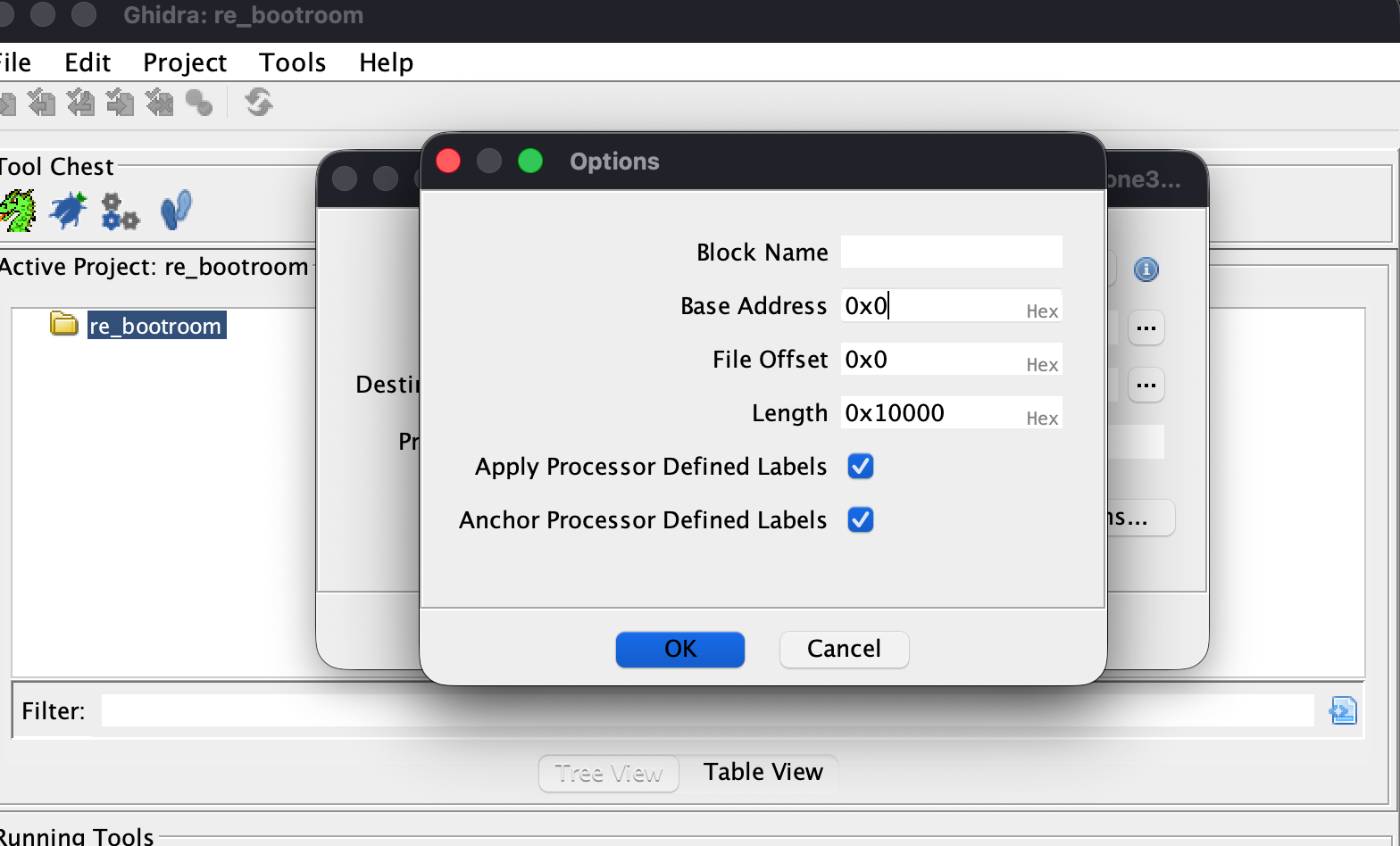
This is the step where it's easy to waste an hour. The import options must match the silicon, or every address Ghidra shows you is wrong and nothing cross-references.
File --> Import File --> bootrom.bin, then:
| Option | Value | Why |
|---|---|---|
| Language | ARM:LE:32:v7 | S5L8920 is a Cortex-A8 (ARMv7-A) core, little-endian, 32-bit |
| Base / Image Base | 0x00000000 | The ROM is mapped at physical 0x0, branches use absolute targets |
| Format | Raw Binary | there is no container to parse |
The mistake: my first import used base address
0x84000000, the SRAM address from Part 1, because that number was burned into my brain from the exploit. Wrong.0x84000000is where our payload copied the ROM to so USB could read it. The ROM itself executes from0x0. Load it at0x0, otherwise the handler table at0x20(which holds absolute addresses like0x000055c0) points into nowhere and Ghidra's auto-analysis finds almost no functions.
One more subtlety that matters a lot on this chip: the SecureROM is a mix of ARM and Thumb code (https://developer.arm.com/documentation/%EE%80%80dui0473/latest/overview-of-the-arm-archi%EE%80%80tecture/arm-and-thumb-instruction-set-ov%EE%80%80erview). A quick primer if the term is new: Thumb is ARM's compact 16-bit instruction encoding. It's the same processor and the same registers, just a narrower set of instructions that take half the space, which is why boot ROMs (where every byte counts) lean on it heavily. The core flips between the two states at runtime, and the low bit of a branch target address selects which one (bit 0 = 1 means "decode the destination as Thumb").
Concretely here: the reset path at 0x40 is 32-bit ARM. Almost everything after it
is 16-bit Thumb. Ghidra's auto-analysis handles a lot of this via the BX/BLX
transitions, but you'll be flipping individual functions between ARM and Thumb by
hand (Ctrl+Shift+G --> set the TMode context register). If a "function" looks
like total garbage, you're decoding Thumb as ARM or vice-versa.
To make this post reproducible without Ghidra, I also disassembled the key regions with Capstone, the little script is at the end of the post. Most of the raw disassembly listings below come straight out of it, where I lean on Ghidra's resolved constants or its decompiler, I'll call it out.
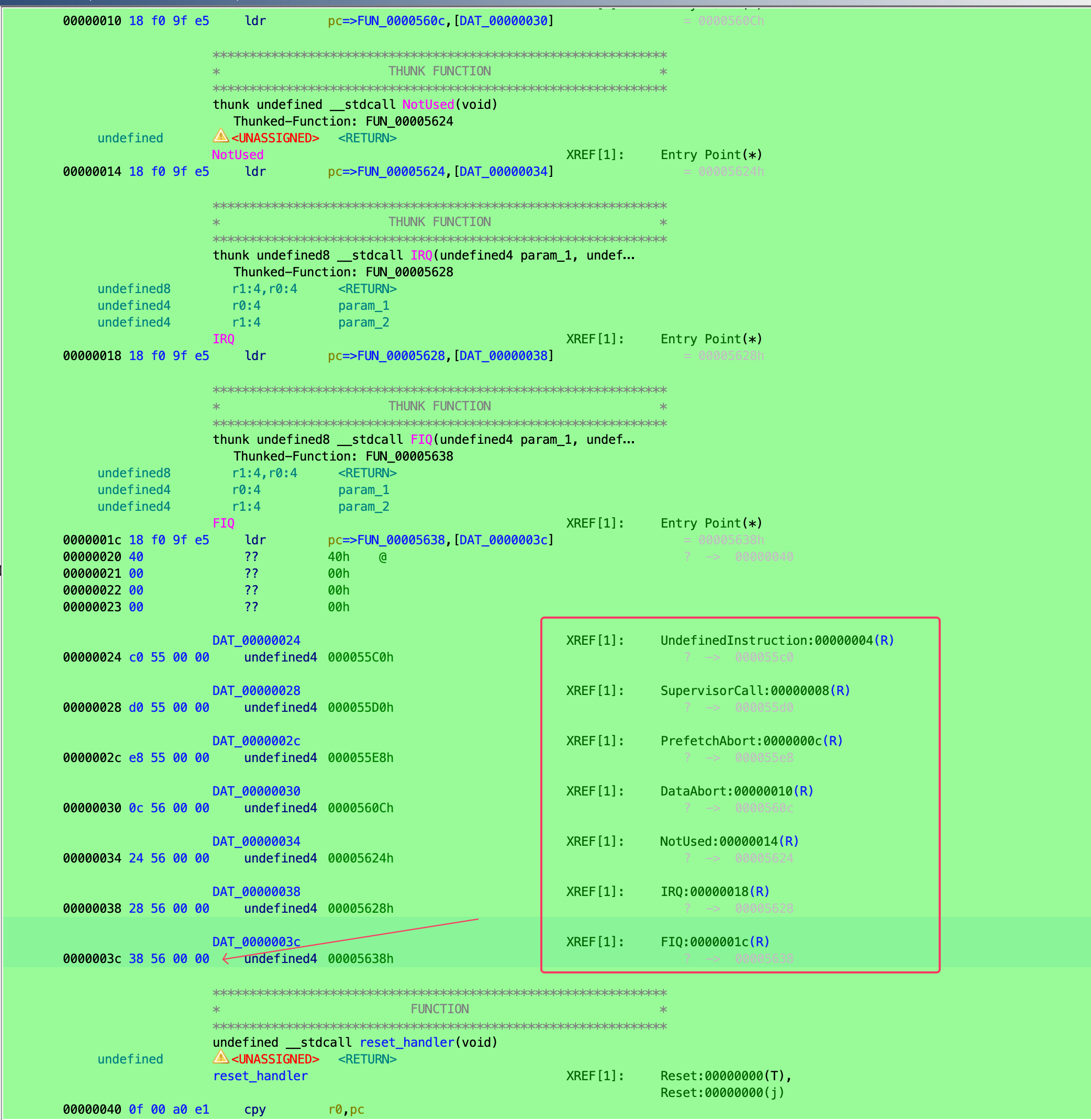
3. The vector table (0x0 - 0x40)
The first 32 bytes are the ARM exception vectors, eight 32-bit slots, one per CPU
exception. On this ROM, seven of them are LDR PC, [PC, #0x18] (load the real
handler address from a table 0x18 bytes ahead), and the first is a direct branch:
0x0000:  b     #0x40              ; Reset  --> jump straight to init
0x0004:  ldr   pc, [pc, #0x18]    ; Undefined Instruction
0x0008:  ldr   pc, [pc, #0x18]    ; Software Interrupt (SVC)
0x000c:  ldr   pc, [pc, #0x18]    ; Prefetch Abort
0x0010:  ldr   pc, [pc, #0x18]    ; Data Abort
0x0014:  ldr   pc, [pc, #0x18]    ; (reserved)
0x0018:  ldr   pc, [pc, #0x18]    ; IRQ
0x001c:  ldr   pc, [pc, #0x18]    ; FIQ
And the table those LDRs read from, sitting right after at 0x20:
Reset          --> 0x00000040
Undefined      --> 0x000055c0
SWI / SVC      --> 0x000055d0
Prefetch Abort --> 0x000055e8
Data Abort     --> 0x0000560c
Reserved       --> 0x00005624
IRQ            --> 0x00005628
FIQ            --> 0x00005638
This is already useful intel. Those seven handlers clustered at 0x55c0-0x5638
are the exception/panic machinery. When our Part 1 exploit sent the stall trigger
and the device "raised an error", this is the region of code that fielded the
resulting fault. We now have its address. (We'll come back to the panic path in a
second, the strings will confirm it.)
In Ghidra: if it hasn't already, mark
0x20-0x40as an array of 8 pointers (Pon the first word, then[for array). Each entry becomes a clickable cross-reference to a handler. Instant map of the CPU's fault surface.
4. The reset handler (0x40): relocation + BSS zeroing
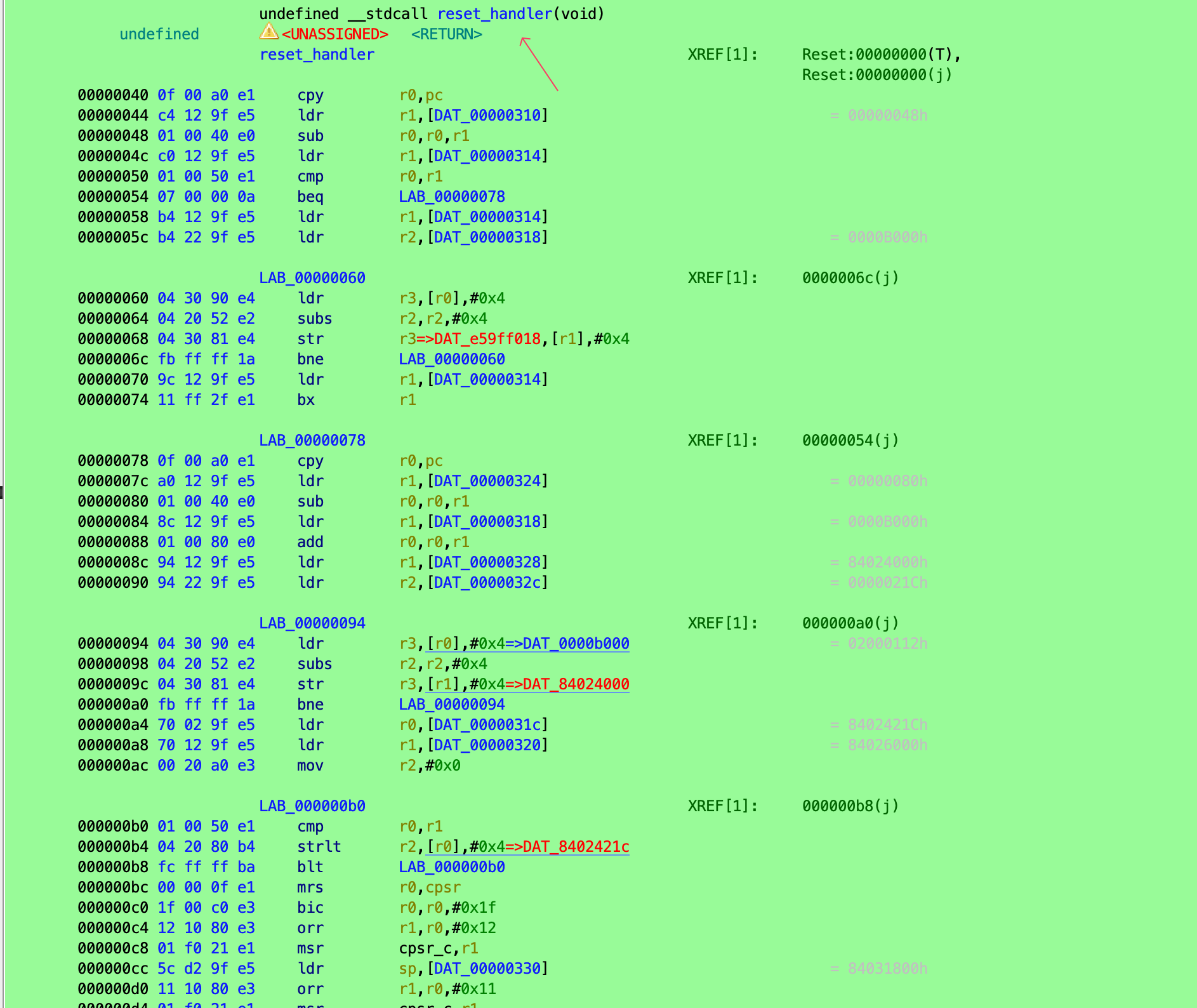
Following the reset branch to 0x40 lands us in 32-bit ARM. This is the very first
code the chip runs on power-on, and it does exactly what a bare-metal reset stub is
supposed to do, figure out where it's running, relocate itself to its link address
if it isn't already there, copy the data segment, zero the BSS, set up a stack for
every CPU mode, and jump into the real firmware. Once Ghidra resolves the literal
pool, the constants turn this from a generic stub into a map of the SecureROM's
runtime memory layout:
; --- relocate self to link address 0x0 (skipped here: already at 0x0) ---
0x0040:  cpy   r0, pc                 ; where am I actually running?
0x0044:  ldr   r1, [DAT_00000310]     ; = 0x48
0x0048:  sub   r0, r0, r1             ; r0 = relocation delta (0 on this device)
0x004c:  ldr   r1, [DAT_00000314]     ; = 0x0  (dst = link address)
0x0050:  cmp   r0, r1
0x0054:  beq   0x78                   ; delta == 0? already home, skip the copy
0x005c:  ldr   r2, [DAT_00000318]     ; = 0xB000  (copy length: 44 KB)
0x0060:  ldr   r3, [r0], #4           ; \  copy code to 0x0 (only runs if the ROM
0x0068:  str   r3, [r1], #4           ; /  is loaded elsewhere; a no-op here)
0x006c:  bne   0x60
0x0074:  bx    r1                     ; jump to the copied-out code

; --- copy data segment + zero BSS ---
0x008c:  ldr   r1, [DAT_00000328]     ; = 0x84024000  (data dst)
0x0090:  ldr   r2, [DAT_0000032c]     ; = 0x21C       (data len)
...                                    ; copy 0x21C bytes of .data
0x00a4:  ldr   r0, [DAT_0000031c]     ; = 0x8402421C  (BSS start)
0x00a8:  ldr   r1, [DAT_00000320]     ; = 0x84026000  (BSS end)
0x00b4:  strlt r2, [r0], #4           ; while (start < end) *start++ = 0

; --- set up a stack for every ARM processor mode ---
0x00bc:  mrs   r0, cpsr
0x00c4:  orr   r1, r0, #0x12          ; IRQ mode
0x00cc:  ldr   sp, [DAT_00000330]     ; = 0x84031800
0x00d0:  orr   r1, r0, #0x11          ; FIQ mode  --> sp = 0x84031800
0x00dc:  orr   r1, r0, #0x17          ; Abort mode --> sp = 0x84031800
0x00e8:  orr   r1, r0, #0x1b          ; Undefined mode --> sp = 0x84031800
0x00f4:  orr   r1, r0, #0x13          ; Supervisor (SVC) mode
0x00fc:  ldr   sp, [DAT_00000334]     ; = 0x84034000   <-- remember this number
0x0100:  ldr   r0, [DAT_0000030c]     ; = 0x6EF
0x0108:  bx    r0                      ; jump into securerom_main() (Thumb, 0x6ee)
So the ROM relocates itself to its link address (a no-op when it's already running
from 0x0), lays out .data at 0x84024000 and .bss up to 0x84026000, gives
IRQ/FIQ/Abort/Undefined modes a stack at 0x84031800, gives
Supervisor (SVC) mode a stack topping out at 0x84034000, and finally bxes
into the main firmware routine at 0x6ee. That's the whole pre-boot world in ~50
instructions.
The number we typed on faith in Part 1
First, what is a "Supervisor stack"? ARM cores don't run in one flat mode. The
processor has several modes (User, Supervisor/SVC, IRQ, FIQ, Abort, Undefined,
System), and a few of them, including SVC, get their own banked stack pointer, a
private SP that's swapped in automatically when the CPU enters that mode. Supervisor
mode is the privileged mode the core boots into and returns to on an SVC call, so
the "Supervisor stack" is simply wherever SP points while the CPU is in SVC mode,
the region the reset handler just pointed at 0x84034000.
Look again at that SVC stack top: 0x84034000. Now recall the single most
important constant from the Part 1 exploit, the address we overwrote to hijack the
Link Register:
EXPLOIT_LR = 0x84033FA4
Do the subtraction:
0x84034000  (top of the Supervisor stack, set up right here at 0x00fc)
- 0x84033FA4 (EXPLOIT_LR)
= 0x5C       (92 bytes)
EXPLOIT_LR sits 92 bytes below the top of the SVC stack, the exact stack this
reset handler just created. The USB/DFU code runs in Supervisor mode, so the saved
return address (LR) that limera1n corrupts lives on this stack. In Part 1 we
copied 0x84033FA4 out of ipwndfu's per-chip table and trusted it blindly. Here's
the static proof of where that number comes from: it's not magic, it's a slot in the
Supervisor stack that the ROM allocates in its very first 50 instructions. Reverse
engineering just turned a copied constant into an understood one. ❤️
A couple of terms worth unpacking, since this is a study project and I'm reasoning
out loud rather than claiming certainty. A relocation delta is just the
difference between where the code is actually executing right now and where it was
built to run. The cpy r0, pc grabs the current address, the sub subtracts the
expected one, and the leftover is how far off we are, if it's zero the code is
already home and the copy loop is skipped. A sanity check is the cheap "does this
even look right?" test you do before trusting anything: here, if disassembling 0x40
doesn't produce this recognizable relocate-then-zero-BSS shape, then I've almost
certainly loaded the file wrong (bad base address, or ARM decoded as Thumb), and I
should fix that before reading another line.
The ordering also seems important, though I'm inferring intent from the code rather
than from any Apple source: the ROM relocates itself, sets up the stacks, and only
then (bx 0x6ee) jumps into the firmware that brings up USB, crypto, and the heap.
If that reading is right, it explains why the exploit can only land later, once the
DFU loop is live and the allocator is actually running, none of the machinery
limera1n abuses exists yet at reset time.
5. Strings are a treasure map
Before grinding through Thumb functions, dump the strings, they're free labels for
half the binary. strings -a -t x (offset in hex) on this ROM is unusually
rewarding:
$ strings -a -t x -n 5 bootrom.bin
     200 SecureROM for s5l8920xsi, Copyright 2008, Apple Inc.
     240 RELEASE
     280 iBoot-359.3.2
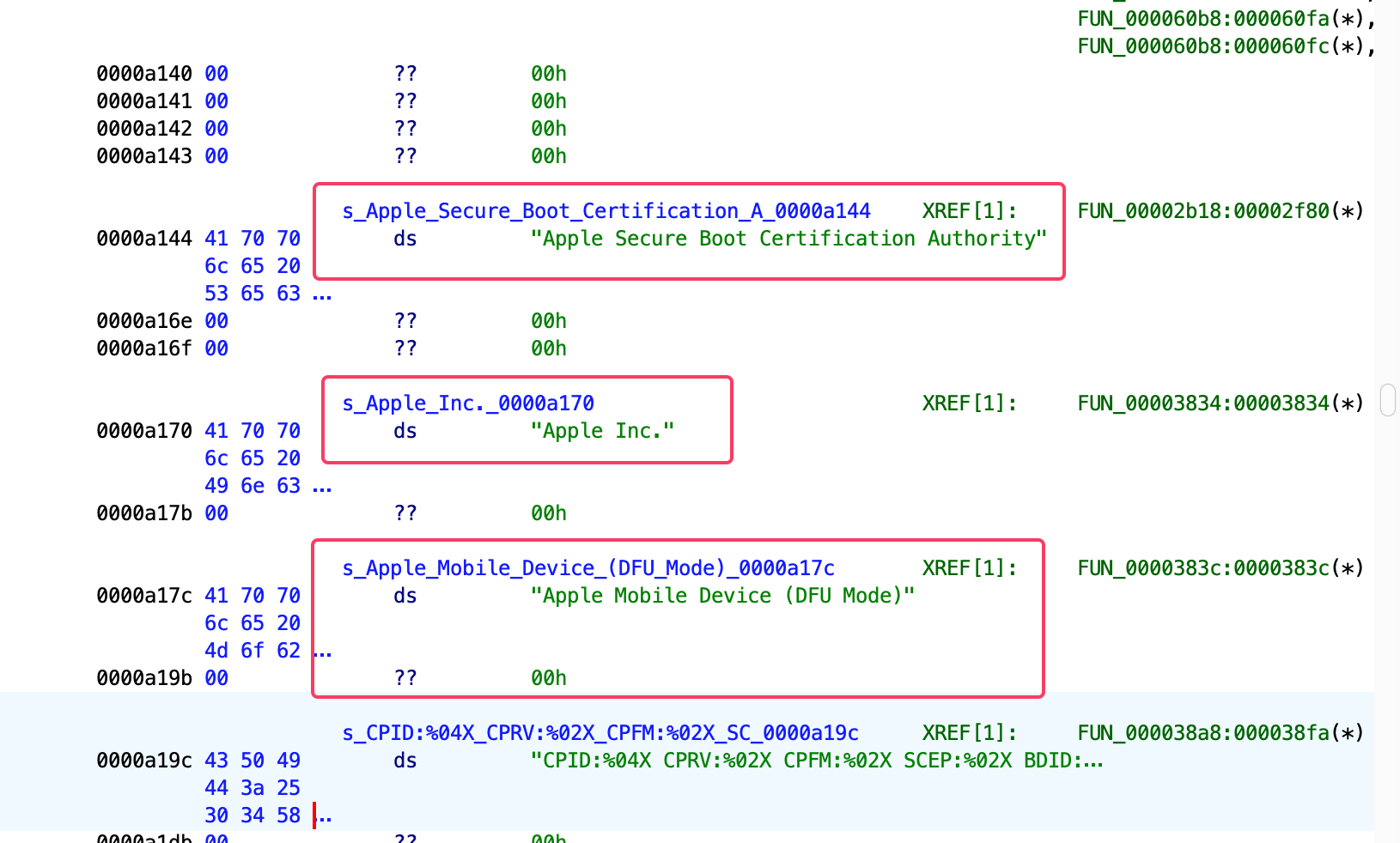
    a144 Apple Secure Boot Certification Authority
    a170 Apple Inc.
    a17c Apple Mobile Device (DFU Mode)
    a19c CPID:%04X CPRV:%02X CPFM:%02X SCEP:%02X BDID:%02X ECID:%016llX
    a1dc  SRTG:[
    a1e8 double panic
    a1f8 panic:
    a204 idle task
    a210 <null>
    ae60 0123456789ABCDEF0123456789abcdef
    b0b0 bootstrap
Let me pull on a few of these threads.
5.1 The banner block (0x200)
0x0200  SecureROM for s5l8920xsi, Copyright 2008, Apple Inc.\0
0x0240  RELEASE\0
0x0280  iBoot-359.3.2\0
s5l8920xsi is the exact SoC (S5L8920 = the 3GS). RELEASE is the build variant
(vs. a DEBUG SecureROM Apple used internally). And iBoot-359.3.2 is the version
string, the same one that showed up in the USB serial in Part 1
(SRTG:[iBoot-359.3.2]). That's not a coincidence...
5.2 The string that printed our own serial number 🤯
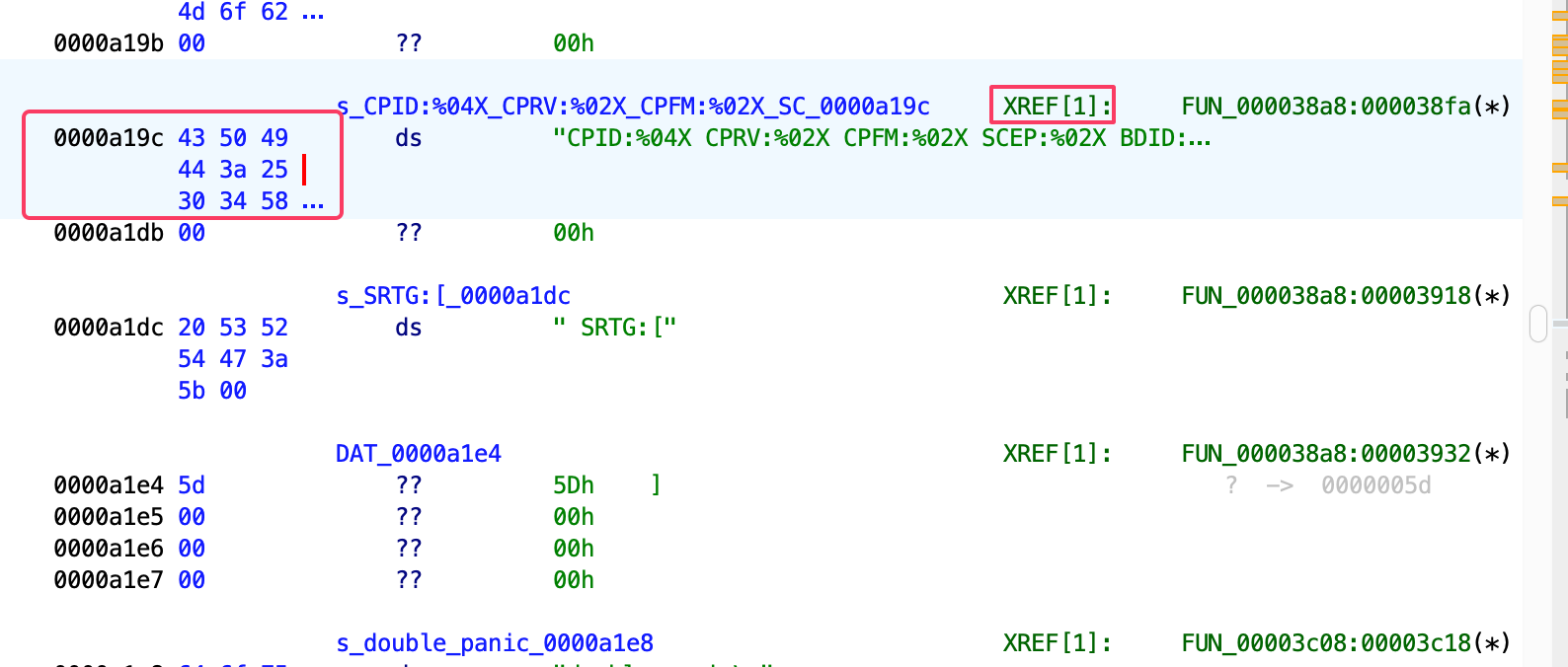
Look at 0xa19c:
CPID:%04X CPRV:%02X CPFM:%02X SCEP:%02X BDID:%02X ECID:%016llX
followed immediately by SRTG:[ and ] at 0xa1dc.
This is the format string that built the DFU serial number we read in Part 1 to identify the chip. Remember this, from the recon step?
CPID:8920 SRTG:[iBoot-359.3.2]
CPID:8920 is how we knew it was a 3GS (S5L8920) and therefore vulnerable to
limera1n. We were, without realizing it, reading the output of this exact
snprintf-style call inside the ROM we've now dumped. The USB descriptor strings
sit right above it:
0xa170  Apple Inc.\0
0xa17c  Apple Mobile Device (DFU Mode)\0
Those are the USB manufacturer/product strings your Mac shows when the phone is in
DFU. Here's why that matters for finding code. A string on its own is dead data, but
a disassembler records every place in the code that references an address, its
cross-references, or xrefs. So if I look up who reads 0xa19c, I get the exact
function that assembles the serial number, and that function lives deep in the code
that sets up USB and answers DFU requests.
That's what I mean by "the neighborhood limera1n lives in": the limera1n bug is a heap corruption in how the SecureROM handles USB/DFU transfers, so the vulnerable code sits in that same USB/DFU cluster. Landing on the serial-builder puts me a few function calls away from the bug itself. Walking backwards from a recognizable string to its xref, instead of reading 45KB of Thumb top to bottom, is one of the fastest ways to parachute straight into the interesting code.
5.3 The panic path
double panic, panic: , idle task, <null> at 0xa1e8-0xa210 are the
strings the exception handlers we found at 0x55c0-0x5638 print. Cross-reference
panic: and you land right in that cluster, confirming what the vector table
already told us.
5.4 The trust anchor: an embedded Apple certificate
0xa144 says Apple Secure Boot Certification Authority, and just after it, at
0xa230, there's a DER-encoded X.509 certificate:
# a DER SEQUENCE is 0x30 0x82 <len_hi> <len_lo>
0xa230:  30 82 03 a3   --> SEQUENCE, length 0x3a3 (931 bytes)
with human-readable fields sprinkled through it:
a265  Apple Inc.
a27a  Apple Certification Authority
a2a2  Apple Root CA
a4f3  https://www.apple.com/appleca/
a524  Reliance on this certificate by any party assumes acceptance of ...
This is a huge find for the series. This baked-in certificate is the root of
trust for the whole boot chain. When the SecureROM loads the next stage (LLB /
iBSS), it verifies an RSA signature over an Image3 (img3) blob, and the chain of
trust terminates here, at a certificate physically burned into the chip. This is
the thing Apple is protecting: you cannot boot code the ROM can't trace back to
this cert.
Which means this cert, and the code that checks signatures against it, is the
target of Part 3. We're going to find the RSA/SHA-1 verification routine, work out
exactly where it decides "signature valid / invalid", and neutralize that decision.
For now it's enough to know where the anchor lives: 0xa230.
There's also a plain hex lookup table at 0xae60:
0123456789ABCDEF0123456789abcdef
That's the alphabet a hex() / byte-to-ASCII helper indexes into, the exact thing
the %02X conversions in the serial string need. Small detail, but finding its
xrefs points you straight at the ROM's string-formatting helper.
6. Meeting an old enemy: the DFU buffer and the heap allocator
Here's the part I was most excited about. In Part 1 we abused a heap overflow
completely blind, we knew the shape of a heap block only from ipwndfu's
constants and pod2g's notes:
struct heap_block {
    uint32_t flags;   // 0x405 = free
    uint32_t size;
    uint32_t prev;    // we overwrote this --> shellcode
    uint32_t next;    // we overwrote this --> LR
};
One term first, because the whole exploit hinges on it: a heap allocator is the
code that hands out dynamic memory on request and takes it back later, the classic
malloc() / free() pair from C. To keep track of what's handed out, an allocator
stores bookkeeping, its metadata, usually in a small header right before each
block: how big it is, whether it's free, and pointers linking it to its neighbors in
a free list. The canonical design almost every embedded allocator borrows from is
Doug Lea's dlmalloc, whose write-up
(A Memory Allocator) explains those
headers and free lists in detail. The reason this matters to us: if you can overwrite
that metadata, you can trick free() into writing an attacker-controlled value to an
attacker-controlled address, which is exactly the primitive limera1n uses.
Now we have the actual allocator in front of us. Let's read it instead of guessing.
6.1 The DFU buffer allocation (0x34a4)
Our payload's usb_wait_for_image (more on that below) calls a function at
0x34a4. Its opening is unmistakable:
0x34a4:  push  {r4, r5, r6, r7, lr}
0x34a6:  mov   r6, fp
...
0x34b4:  movs  r0, #0x80
0x34b6:  movs  r3, #0x32
0x34b8:  lsls  r0, r0, #4          ; r0 = 0x80 << 4 = 0x800   <-- DFU chunk size!
0x34ba:  str   r3, [r6]            ; r3 = 0x32 = 50 (a status/timeout constant)
...
0x34c4:  bl    #0x1aa8             ; malloc(0x800)
0x34c8:  ldr   r3, [pc, #0xe8]
0x34ca:  str   r0, [r3]            ; stash the buffer pointer in a global
0x34cc:  cmp   r0, #0
0x34ce:  beq   #0x359c             ; bail if allocation failed
That 0x800 is the exact DFU transfer chunk size we streamed data in during
Part 1 (chunk = data[idx:idx+0x800]). So 0x34a4 sets up the DFU transfer buffer
by calling the real allocator at 0x1aa8 with size 0x800. We just found
malloc.
6.2 The allocator (0x1aa8) and the free-side validation (0x1fa8)
0x1f80 is a small wrapper that allocates a 0x18-byte object and initializes it:
0x1f80:  push  {r4, r5, r6, r7, lr}
0x1f88:  movs  r0, #0x18           ; malloc(0x18), a 24-byte descriptor
0x1f8a:  movs  r1, #0
0x1f8e:  bl    #0x1aa8             ; <- the real allocator again
0x1f92:  cmp   r0, #0
0x1f94:  beq   #0x1fa2
0x1f96:  ldr   r3, [pc, #0xc]
0x1f98:  str   r4, [r0]            ; obj->field_0 = ...
0x1f9a:  str   r4, [r0, #4]        ; obj->field_4 = ...
0x1f9c:  str   r3, [r0, #0xc]      ; obj->field_c = <magic/tag>   <-- note offset 0xc
0x1f9e:  str   r5, [r0, #0x10]
0x1fa0:  str   r6, [r0, #0x14]
0x1fa2:  pop   {r4, r5, r6, r7, pc}
And right after it, the free / release path at 0x1fa8:
0x1fa8:  push  {r7, lr}
0x1faa:  ldr   r2, [r0, #0xc]      ; read obj->field_c  <-- same offset 0xc
0x1fac:  ldr   r3, [pc, #0xc]      ; load the expected magic
0x1fae:  add   r7, sp, #0
0x1fb0:  cmp   r2, r3              ; block->tag == expected?
0x1fb2:  bne   #0x1fb8             ; mismatch --> skip the real free
0x1fb4:  bl    #0x1ccc             ; the actual free()
0x1fb8:  pop   {r7, pc}
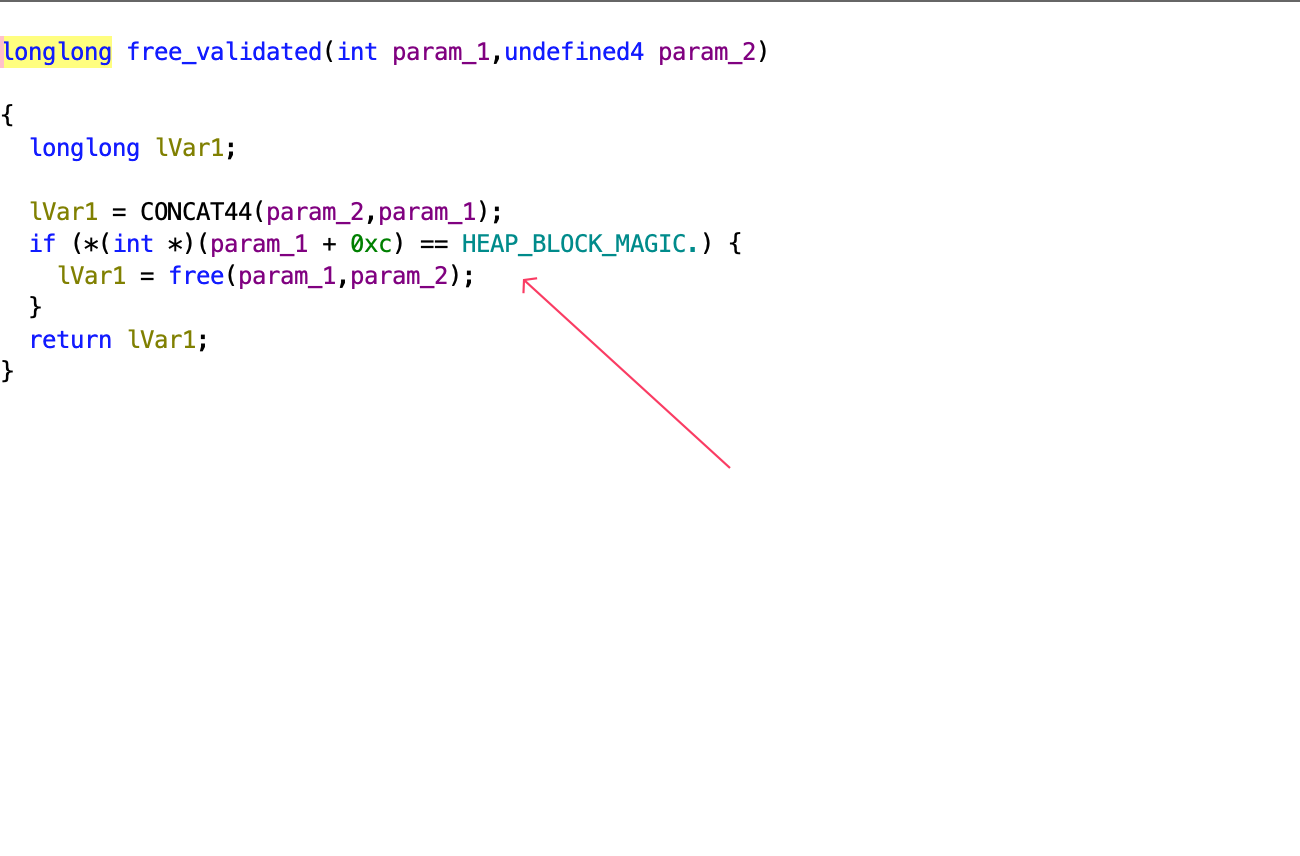
Decompiled, that whole function is four lines, and the "known-good constant" has a name:
longlong free_validated(int block, undefined4 param_2)
{
    if ( *(int *)(block + 0xc) == 0x4d656d7a )   // 0x4d656d7a == 'Memz'
        free(block, param_2);
    return ...;
}
0x4D656D7A is ASCII Memz (stored little-endian in the ROM as the bytes
7a 6d 65 4d). It's a magic canary: the wrapper at 0x1f80 stamps it into the
0x18-byte descriptor objects it hands out, and 0x1fa8 won't release one unless the
canary still matches. Sitting right next to it in the literal pool is
0x696D6733 = img3, the magic for Apple's signed-image container, a good hint
that these descriptors describe images. Confirmation that offset 0xc is the magic
and not a pointer: 0x1f80 writes the same value with str r3, [r0, #0xc]. One
function stamps Memz, the other checks it.
Here's the part I had to slow down on. 0x1fa8 is not the general free. It's a
descriptor free, gated by Memz, that then calls the real free at 0x1ccc. In
the DFU loop above it's only ever called on the objects 0x1f80 returns: the
0x18-byte image descriptors, already stamped with Memz. The chunk limera1n forges
is a plain heap block, not one of those descriptors, so its free has to go through
the unguarded 0x1ccc: if it ever hit the Memz cmp at 0x1fb0 it would be
rejected and the unlink would never fire. (The check reads [user_ptr + 0xc]; the
spray forges the fd/bk links at [user_ptr + 0] / [user_ptr + 4] to steer the
unlink, and never puts Memz where the check looks, so the forged chunk can't pass
it.) The attack works precisely because the corrupted chunk's free does not pass
through this check. That's the real shape of the bug: a validated free exists in the
ROM, but it guards the wrong object, and the DFU buffer is released through the
unvalidated path, which is the door limera1n walks through.
In other words: Part 1 was us punching this allocator in the dark. Part 2 is us
turning the lights on and finding the door we actually used. In a later post I
want to trace the full malloc/free at 0x1aa8/0x1ccc, recover the real header
layout field by field, and line it up against the sprayed values, a proper autopsy
of the bug now that we can read the victim.
7. Reading our own exploit's landing pad: usb_wait_for_image (0x8b7)
Full-circle moment. In Part 1, the last thing our 76-byte payload did was call an address we treated as a magic number:
.set RET_ADDR, 0x8b7          @ usb_wait_for_image on 3GS SecureROM 359.3.2
    ...
    LDR  R3, =RET_ADDR
    BLX  R3                    @ hand control back to the ROM's USB loop
We called 0x8b7 on faith, pod2g's notes said "this re-arms USB so the Mac can
DFU_UPLOAD your buffer," and it worked. Now we can actually read it. (The +1
makes it Thumb, so the function starts at 0x8b6.)
0x08b6:  bl    #0x34a4            ; set up the DFU transfer buffer (section 6.1!)
0x08ba:  cmp   r0, #0
0x08bc:  blt   #0x8e6            ; error path if setup failed
0x08be:  mov   sl, r0
0x08c0:  movs  r0, #0x84
0x08c2:  lsls  r0, r0, #0x18      ; r0 = 0x84 << 24 = 0x84000000   <-- our SRAM base!
0x08c4:  mov   r1, sl
0x08c6:  movs  r2, #0
0x08c8:  bl    #0x1f80            ; wrap the buffer in a descriptor (section 6.2)
0x08cc:  adds  r5, r0, #0
0x08d0:  beq   #0x8e6
0x08d2:  movs  r1, #0x84
0x08d6:  lsls  r1, r1, #0x18      ; 0x84000000 again
0x08da:  mov   r2, sl
0x08dc:  bl    #0x6b8             ; register / kick off the USB transfer
0x08e2:  bl    #0x1fa8            ; release descriptor (the validated free!)
...
0x08f6:  b     #0x7d4             ; back into the DFU command loop
Everything lines up with what actually happened on the wire in Part 1:
bl 0x34a4, allocates the0x800DFU buffer.movs r0,#0x84, lsls r0,#0x18, materializes0x84000000, the SRAM address our payload hadmemcpy'd the ROM to. This function points the USB machinery at that buffer.bl 0x1f80/bl 0x1fa8, the allocator wrapper and validated-free we just reverse engineered.b 0x7d4, jumps back into the main DFU request loop, which is why, after our shellcode returned here, the Mac could immediately issueDFU_UPLOAD (0xA1/2)and stream 65536 bytes out. That's the dump.
So the "magic number" 0x8b7 was the ROM's own "(re)initialize the USB image
transfer path" routine. We borrowed Apple's USB stack to exfiltrate Apple's ROM. 🙂
Step back from 0x8b6 and the shape of the whole thing appears. 0x8b6 isn't its own
function, it's one branch of the SecureROM's main DFU service loop (FUN_000006ee
at 0x6ee, the bx 0x6ef target from the reset handler): an infinite
do { } while (true) that never returns. Each pass waits for a USB control request
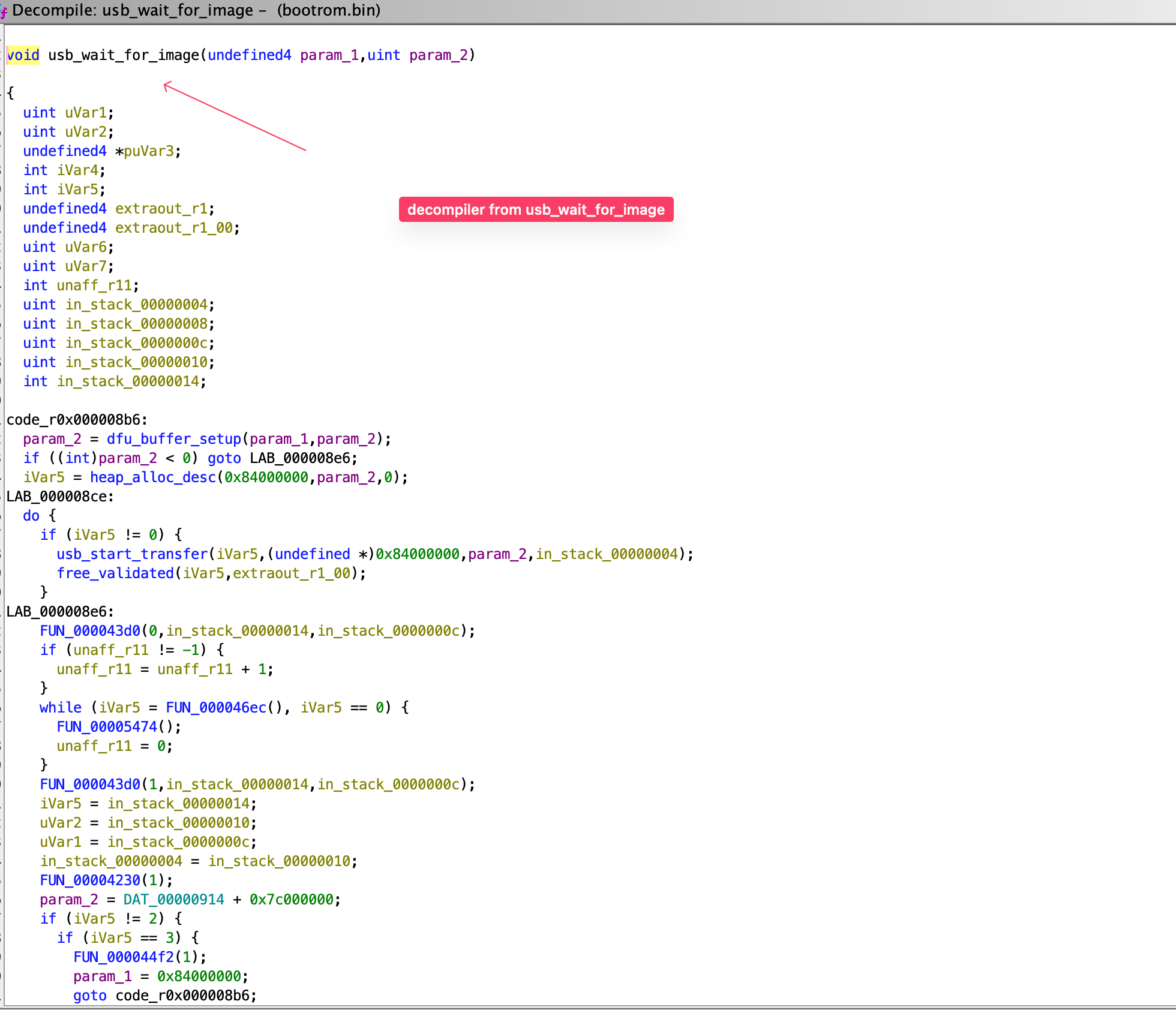
and dispatches on it. Reconstructed from the decompiler (the req numbers are the
ROM's internal command enum, not the USB bRequest values):
void securerom_main(void)                    // never returns
{
  ...
  do {
    req = dfu_get_request();                 // wait for a USB control request
    if (req == 2) {                          // DFU_DNLOAD: host sends an image
        // FUN_00004e18 receives into 0x84000000 (4 endpoints x 0x200),
        // 0x1f80 wraps it in a descriptor, then FUN_000006b8 validates+loads it
    }
    else if (req == 3) {                     // DFU_UPLOAD: host reads device memory
        size = dfu_buffer_setup(0x84000000, size);   // 0x34a4, alloc the 0x800 buffer
        desc = heap_alloc_desc(0x84000000, size, 0); // 0x1f80
        usb_start_transfer(desc, 0x84000000, size);  // expose 0x84000000 to host
        //  *** this is the branch that streamed our 65536-byte dump to the Mac ***
        //  *** our payload re-enters here at 0x8b6 (RET_ADDR 0x8b7)            ***
    }
    else if (req == 1) {                     // third command -- see caveat below
        // looks up a named entry in a registry (FUN_00001350) and loads it;
        // NOT confirmed as DFU_GETSTATUS
    }
  } while (true);
}
The req == 3 (UPLOAD) branch is the one our Part 1 dump actually rode: 0x34a4
points the USB machinery at 0x84000000 so the host can read it back, exactly what
our Mac's DFU_UPLOAD (0xA1/2) requests pulled down. That's also the branch our
payload jumps back into at 0x8b6. The req == 2 (DNLOAD) branch is where the host
sends an image and the ROM receives it into 0x84000000.
Two caveats I'd rather flag than paper over, because the rest of this section leans on them:
req == 1is not a clean fit for DFU_GETSTATUS. Standard DFUGETSTATUSjust returns a 6-byte status struct, but this branch looks up a named entry in a linked-list registry (FUN_00001350, comparing a global name string) and then runs the same load path as the other two. It may be a vendor command or the state-advance step, but I haven't proven the numbering.FUN_000046ecdispatches the USBbRequestthrough a jumptable Ghidra couldn't recover, so the internalreqvalues are inferred from behavior, not read off the spec.The signature check is not specific to
req == 2. All three load paths funnel throughFUN_000006b8, which callsFUN_00001f00(it gates on the descriptor's type tag at+0xcbeingMemzorimg3) and thenFUN_000024dc, a 728-byteimg3container parser that checks the image starts with theimg3magic and is where the real signature/certificate verification lives. That shared verifier, not any single DFU branch, is what Part 3 will attack.
8. The map so far
Putting the confirmed pieces together, here's the working memory map of the 3GS SecureROM 359.3.2 after this session:
Offset        What                                  How I know
------------------------------------------------------------------------------
0x0000-0x001f Exception vector table (ARM)          disassembly: B / LDR PC
0x0020-0x003f Handler address table                 8 absolute pointers
0x0040-~0x1ff Reset / relocation / BSS clear (ARM)   MOV R0,PC + copy loop
0x0200        "SecureROM for s5l8920xsi ... 2008"    banner string
0x0240        "RELEASE"                             build variant
0x0280        "iBoot-359.3.2"                       version (matches SRTG)
0x06ee        securerom_main (firmware entry)       bx target from reset_handler
~0x06xx+      Thumb code region begins              BX/BLX into Thumb
0x06b8        image load: validate + execute         shared by all DFU load branches
0x08b6        usb_wait_for_image (our RET_ADDR!)     payload target 0x8b7
0x1aa8        malloc (general allocator)            called with size in r0
0x1ccc        free (general release + unlink)        the unguarded path limera1n rides
0x1f00        image type gate (Memz / img3 @+0xc)    -> FUN_000024dc
0x1f80        alloc+init 0x18-byte descriptor       stamps Memz at +0xc
0x1fa8        validated free (checks Memz at +0xc)   descriptor free, NOT the exploited path
0x24dc        img3 parser + sig verify (728 B)       Part 3 target, reached via 0x6b8
0x34a4        DFU upload-buffer setup (0x800)        chunk size == Part 1
0x55c0-0x5638 Exception / panic handlers            vector table + "panic:"
0xa144        "Apple Secure Boot Certification..."   string
0xa170        USB DFU descriptor strings            "Apple Mobile Device (DFU Mode)"
0xa19c        DFU serial format string              "CPID:%04X ... ECID:%016llX"
0xa230        Embedded Apple Root CA cert (931 B)    DER 30 82 03 a3
0xae60        hex digit table                       "0123...ABCDEF0123...abcdef"
0xb0b0        "bootstrap"                           string
0xb218        last non-zero byte                    ~45KB used, rest is padding
And the runtime SRAM layout the reset handler builds before the firmware even starts (these are the live addresses, not ROM offsets, recovered from the resolved literal pool in section 4):
0x84024000            .data segment (0x21C bytes copied here)
0x8402421C-0x84026000 .bss (zeroed)
0x84031800            IRQ / FIQ / Abort / Undefined mode stacks
0x84034000            Supervisor (SVC) mode stack top
  0x84033FA4          <-- EXPLOIT_LR: 0x5C below the SVC stack top (Part 1)
Not bad for a binary that had no header, no symbols, and no ground truth except a
few community-documented addresses. Every row above I either disassembled or
xref'd out of my own dump, and each one is a labeled anchor to keep working from
in Ghidra. The single best payoff: EXPLOIT_LR stopped being a number copied from
someone else's tool and became a slot in a stack we watched the ROM allocate.
9. What's next (Part 3)
We now understand the terrain:
- how the chip boots (
0x0--> reset0x40--> relocate --> Thumb world), - where it talks USB (the DFU loop around
0x7d4,usb_wait_for_imageat0x8b6), - how it manages memory (the allocator at
0x1aa8/0x1ccc, and theMemzheap canary on the descriptor free at0x1fa8that limera1n sidesteps by corrupting a buffer freed through the unguarded0x1ccc), and - where its root of trust lives (the Apple Root CA at
0xa230).
Part 3: Bypassing the Boot Chain is where this gets offensive again. The plan:
- Trace into the Image3 (
img3) parser we already located (FUN_000024dc, §7) to find the RSA/SHA-1 signature verification routine that validates the next boot stage against the0xa230certificate. - Locate the single branch where "signature valid?" becomes a yes/no decision.
- Patch it, in memory, live, right after the limera1n exploit hands us execution, so the ROM happily accepts a stage we signed (i.e. didn't).
That's the difference between "I can read Apple's boot code" and "I can make the device boot my code." See you there. ❤️
Appendix A: reproduce this with Capstone
No Ghidra required to follow along with the raw disassembly in this post. Most of those listings came out of this (the decompiler views and resolved constants are Ghidra's, as flagged inline):
#!/usr/bin/env python3
# pip3 install capstone
import struct
from capstone import *

d = open('bootrom.bin', 'rb').read()
u32 = lambda o: struct.unpack('<I', d[o:o+4])[0]

arm   = Cs(CS_ARCH_ARM, CS_MODE_ARM)     # for 0x0..~0x1ff
thumb = Cs(CS_ARCH_ARM, CS_MODE_THUMB)   # for almost everything else

def show(md, start, length, label):
    print(f"--- {label} @ 0x{start:x} ---")
    for i in md.disasm(d[start:start+length], start):
        print(f"  0x{i.address:04x}:  {i.mnemonic} {i.op_str}")

# 1. vector table + handler pointers
show(arm, 0x0, 0x20, "vector table (ARM)")
for n, name in enumerate(['Reset','Undef','SWI','PAbort','DAbort',
                          'Reserved','IRQ','FIQ']):
    print(f"  {name:10s} --> 0x{u32(0x20 + n*4):08x}")

# 2. reset handler
show(arm, 0x40, 0x80, "reset / init (ARM)")

# 3. the functions our Part 1 exploit touched (all Thumb --> even address)
show(thumb, 0x8b6,  0x50, "usb_wait_for_image (payload RET_ADDR 0x8b7)")
show(thumb, 0x34a4, 0x30, "DFU buffer setup (0x800 chunk)")
show(thumb, 0x1f80, 0x30, "alloc+init descriptor")
show(thumb, 0x1fa8, 0x20, "validated free (reads block[0xc])")
Appendix B: seeding Ghidra (why the landing pad needs a nudge)
One workflow gotcha worth documenting. The reset handler enters the main firmware
through an indirect branch (ldr r0, [=0x6ef]; bx r0), and everything from there is
Thumb. 0x8b6 isn't a routine of its own, it lives inside securerom_main, the
~540-byte function at 0x6ee (FUN_000006ee, spanning 0x6ee-0x90a) that the
reset handler jumps to. Depending on your analysis options, that region can come out
under-analyzed, and even when Ghidra does recover the big function, the exact spot our
payload lands on (0x8b6) has no name of its own, which makes it a pain to decompile
in isolation.
I made this reproducible with a tiny Ghidra pre-script (SeedDisasm.py): it pins ARM
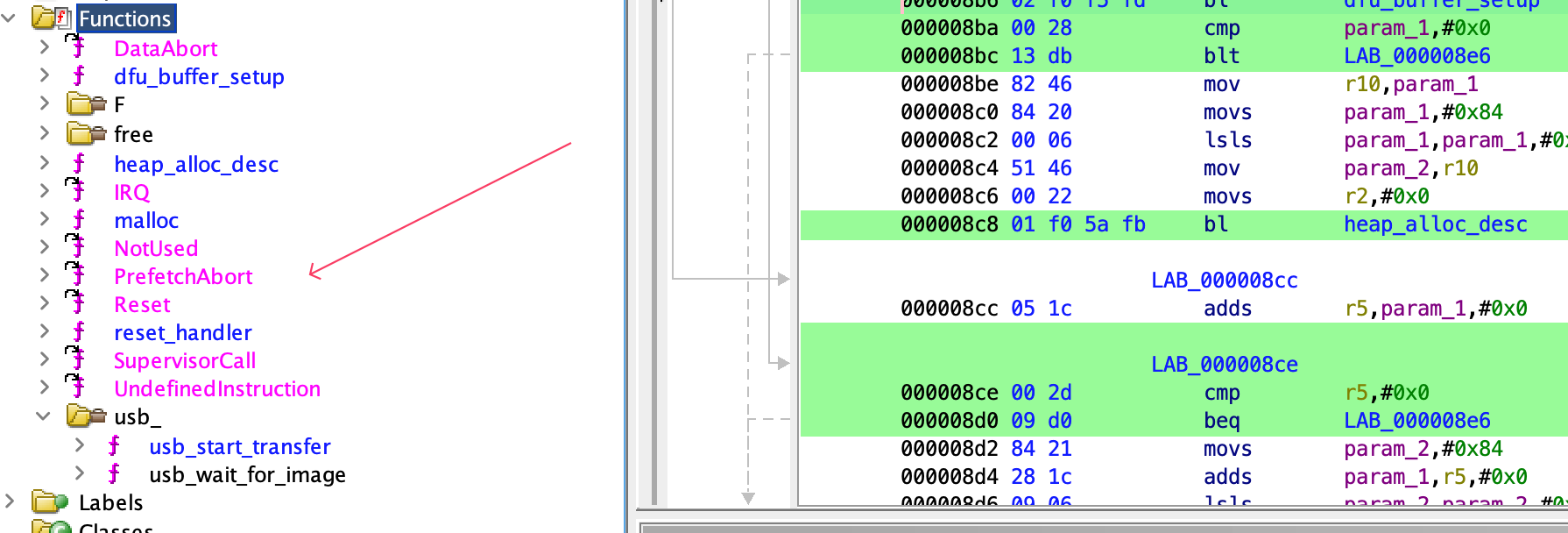
mode on the vector table at 0x0, disassembles Thumb at 0x8B7, and carves out a
named usb_wait_for_image function at 0x8b6 so the landing pad decompiles on its
own:
# Ghidra pre-script, run before Auto Analyze
from ghidra.app.cmd.disassemble import ArmDisassembleCommand
from ghidra.program.model.address import AddressSet
from ghidra.program.model.symbol import SourceType

space = currentProgram.getAddressFactory().getDefaultAddressSpace()

def seed(off, thumb, name=None):
    addr = space.getAddress(off & ~1)          # instructions live at even addrs
    ArmDisassembleCommand(addr, AddressSet(addr), thumb).applyTo(currentProgram, monitor)
    if name:
        fn = getFunctionAt(addr) or createFunction(addr, name)
        if fn: fn.setName(name, SourceType.USER_DEFINED)

seed(0x0,   False)                              # ARM vector table
seed(0x8B7, True, "usb_wait_for_image")         # Thumb; low bit = Thumb, entry is 0x8b6
Two Jython foot-guns cost me a few minutes each: the file needs a
# -*- coding: utf-8 -*- line if any comment has a non-ASCII character (an em-dash
did it), and ArmDisassembleCommand is the clean way to set Thumb mode, the
generic DisassembleCommand wants you to poke the TMode register with a
java.math.BigInteger, which is a hassle.

Appendix C: references
- ipwndfu (axi0mX), https://github.com/axi0mX/ipwndfu, reference limera1n sequence and the per-chip constants.
- The iPhone Wiki - S5L8920 / SecureROM, https://www.theiphonewiki.com/wiki/S5L8920, community notes on the 3GS ROM.
- Ghidra, https://ghidra-sre.org/, the ARM/Thumb disassembler used here.
- Capstone, https://www.capstone-engine.org/, the scriptable disassembler behind the listings.